
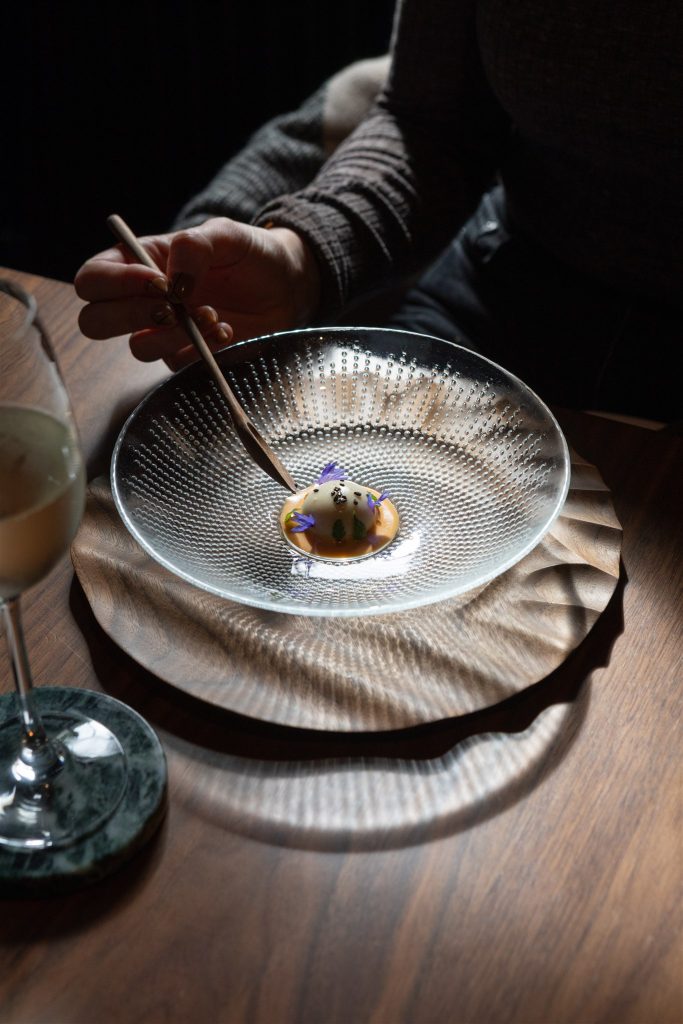
Porridge has been eaten within the whitewashed walls of Killiecrankie House since 1840 – but it’s never tasted quite like this before. Oats slow-cooked with confit duck legs and wagyu oxtail, shaped into bite size bricks, fried deep gold in duck fat and crowned with umami flecks of Isle of Mull cheddar. It’s chef-patron Tom Tsappis’ haute riff on the ‘porridge drawer’ once found in humble Highland homes, which saw oats poured into the family kitchen dresser and left to set, before being sliced into bars. Next on the tasting menu, there’s salmon, another mainstay of the Scottish larder – only Tom seasons his with ponzu and then encases it in a seaweed cornet, sushi-style. Hyper-regional yet worldly and playful, such dishes have stoked rumours of an imminent Michelin star.
 The backdrop at this restaurant-with-rooms has equally cosmopolitan flair: artworks wink knowingly from ink-dark walls (a framed aspirin packet in the cocktail bar; a still life of a haggis) beside Murano glass lamps and mid-century seating. Kilner jars labelled ‘fir vodka’, ‘larch rose vinegar’ and ‘pickled rhubarb’ glint tantalisingly from the shelves of the open kitchen. Psychedelic soul drifts from the ‘sound system’; for each service, a different team member picks a record from Tom’s soaring stack. In short, Killiecrankie House is as cool as a Highlands winter.
This is hardly the dining experience I expected to find on the fringes of the Cairngorms National Park – a swathe of north-east Scotland known for its rugged, mountainous terrain and wildlife rather than the heights of gastronomy or style. Elemental and seemingly impervious to trends, it’s a place that plunges visitors back into Deep Time: a granite massif formed by the collision of continents some 450 million years ago, the creep of Ice Age glaciers sculpting glens and lochs, peat bogs deepening through millennia in liquid silence, and the ruddy trunks of Scots pines thickening over centuries. Where signs of habitation arose, it would typically be a dour, draughty hunting lodge presiding over the heather, a village huddled at the base of a Munro, or perhaps a tumbledown bothy where hikers would tough out the nights.
Look deeper within those glens and communities, though, and you’ll see that something new is emerging and gathering steam. Dining rooms down old military roads. Artisan food and drink startups mushrooming in remote villages. Storied sporting estates shrugging off their stuffy airs and flinging open their gates to a different kind of tourism.
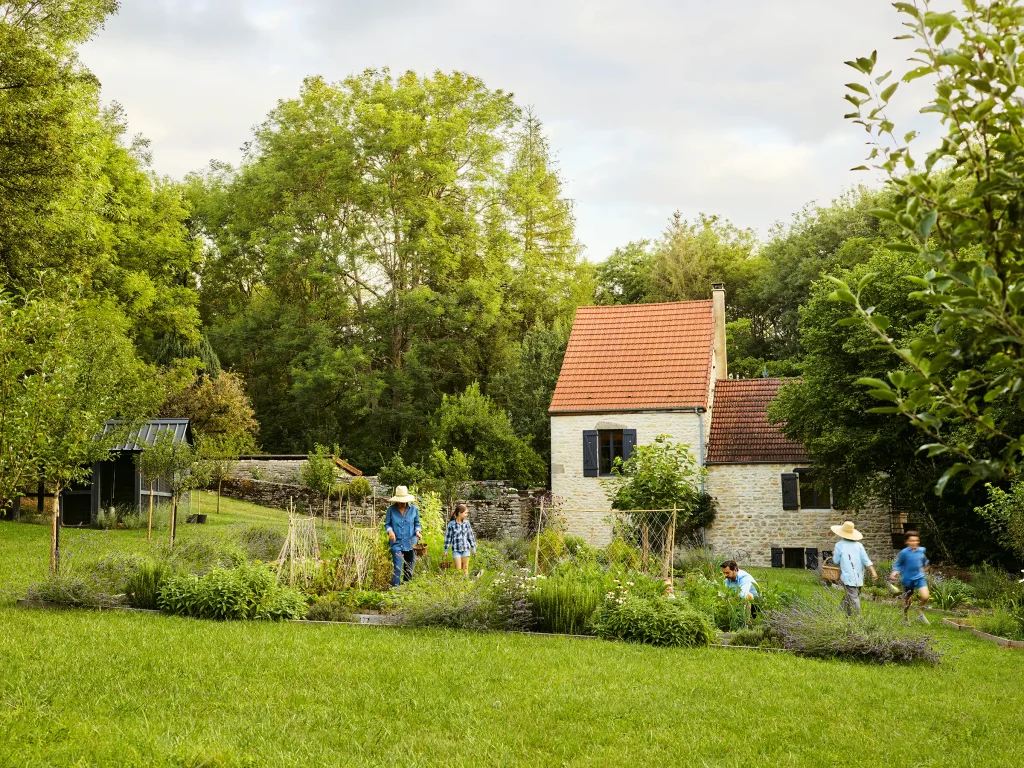
In the eastern Cairngorms, Glen Dye may have been owned by the same family for seven generations, but its evolution into a bohemian, carefree retreat is writ large on its Coach House’s exterior – a turquoise-and-fuchsia mural splashed across 300-year-old stone that proclaims ‘Glen Dye Makes Me Happy’.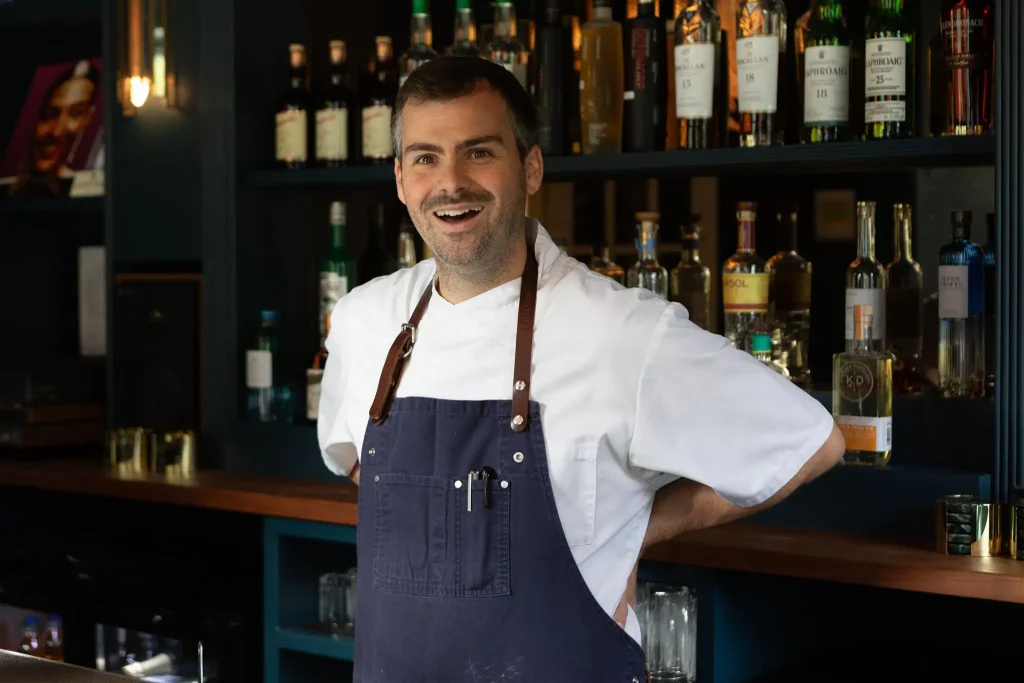
Whimsically worded billboards peep between the redwoods across the 15,000-acre estate, too, while the bold colour-blocking and eclectic artworks continue across Glen Dye’s 11 self-catering cottages and cabins.
‘Country house aesthetic definitely still has its place in some of our properties, but I think the juxtaposition of old and new – gilt-framed oil paintings and modern art; chintzy sofas and modern furniture – makes our properties more relevant to today’s tourists and more comfortable in every sense,’ says Caroline Gladstone, who, together with husband Charlie, spent 25 years restoring these dilapidated buildings – the couple drawing on their respective backgrounds in London’s design and music scenes.
Now, in grounds that have witnessed many a grouse-shooting, deer-stalking or salmon fishing outing, guests can try their hand at basket weaving, whittling, sketching, metal casting and much more. There’s even a dedicated Spotify playlist to accompany forest-bathing walks through the arboretum. And, adding a dash of hedonism to all the wholesomeness, there’s a BYOB pub on site.
Glen Dye keeps company with a growing roster of design-forward Cairngorms boltholes, like Gairnshiel Lodge, where 18th-century interiors have been given a moodily monochrome reboot inspired by the Japanese philosophy of wabi-sabi. Then, there’s Killiehuntly Farmhouse and Glenfeshie Lodge – both part of ambitious landscape-conservation project Wildland – whose stripped-back, sheepskin-swathed interiors prompted Vogue to coin an entirely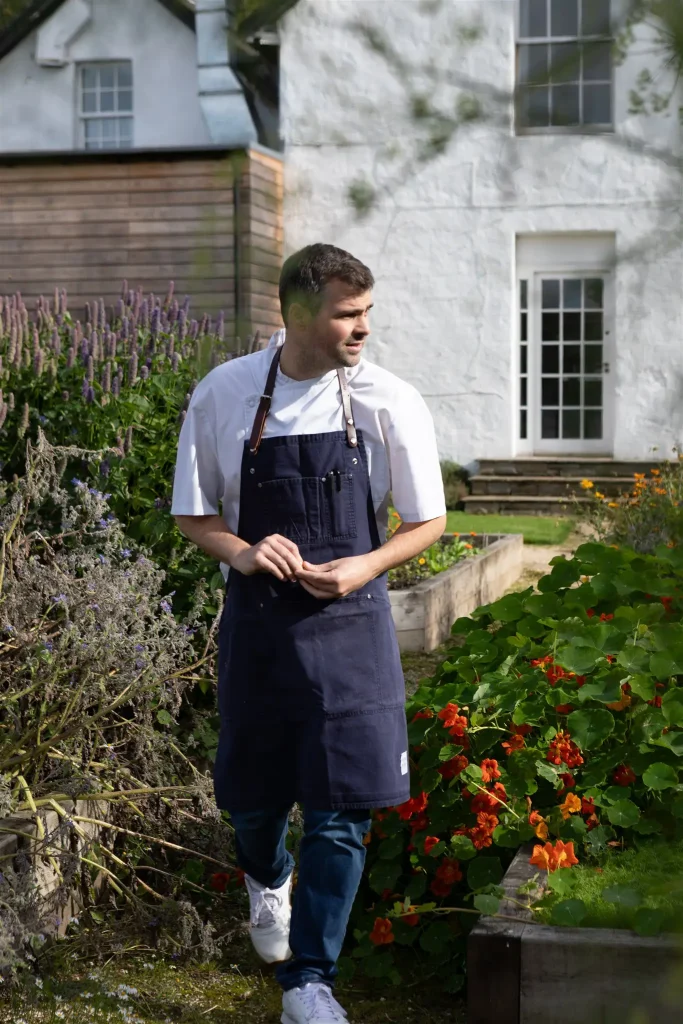 new aesthetic, ‘Scandi Scot’. Private catering has had to step up in turn, with Scottish chefs such as Ruaraidh Menzies of Ror’s Kitchen and Ghillie Basan often breaking out of the dining room and into their wild surroundings, wowing guests with foraged ingredients cooked on the open fire. They’re essentially doing for Cairngorms cuisine what Francis Mallmann did for Patagonia in the 1990s.
From Glen Dye, I drive 40 miles west along the River Dee to Ballater. Wood smoke drifts from granite cottages into the crisp autumn air, and pine covered hills rear above the rooftops as I cross the village square towards Fish Shop. Don’t be fooled by the low-key name and blue-striped awnings; this is no run-of-the-mill Scottish chippie, but rather an art-filled bistro where sustainable seafood sings with globe-hopping flavours. There are loch clams in an emerald-hued pool of mojo verde, handmade tagliarini swirled through a rich Macduff lobster sauce with a chilli kick, and even tattie scones, appearing as elegant, blini-like morsels, perfect for scooping up a smoky whipped cod’s roe – a reminder of the Cairngorms’ proximity to thriving North Sea harbours such as Stonehaven and Peterhead.
Pretty as the plating is, there’s a lot to divert attention both overhead – a shoal of basket-woven fish suspended from the ceiling, portraits of local fishermen, antique ship’s lanterns – and beneath the communal table, an entire salvaged boat forming its base. Such show-stopping pieces were bound to be part of the mix given that Fish Shop has the same owners as international mega-gallery Hauser & Wirth. The latter galvanised the new wave of luxury tourism in the Cairngorms when it launched in 2018, with an in-house art collection that includes original Picassos.
Art royalty aside, this is also the village fishmonger, and the overarching vision, according to general manager Jasmine Sherry, was to have a restaurant ‘where people could sit at the bar for a few snacks, an oyster and a glass of wine, and leave with change from £20, but, equally, go all out on a lobster or turbot tranche for a special occasion’.
It shows that the new wave of Highlands hospitality reaches beyond flagship estates and fine-dining restaurants and is also rippling across local communities. Take the Perthshire village of Dunkeld. Defying the current sorry state of so many British high streets, here, artisan bakery Aran rubs shoulders with Redwood Wines, where seasonal small plates accompany a formidable selection of bottles, just around the corner from LÒn Store’s gourmet provisions.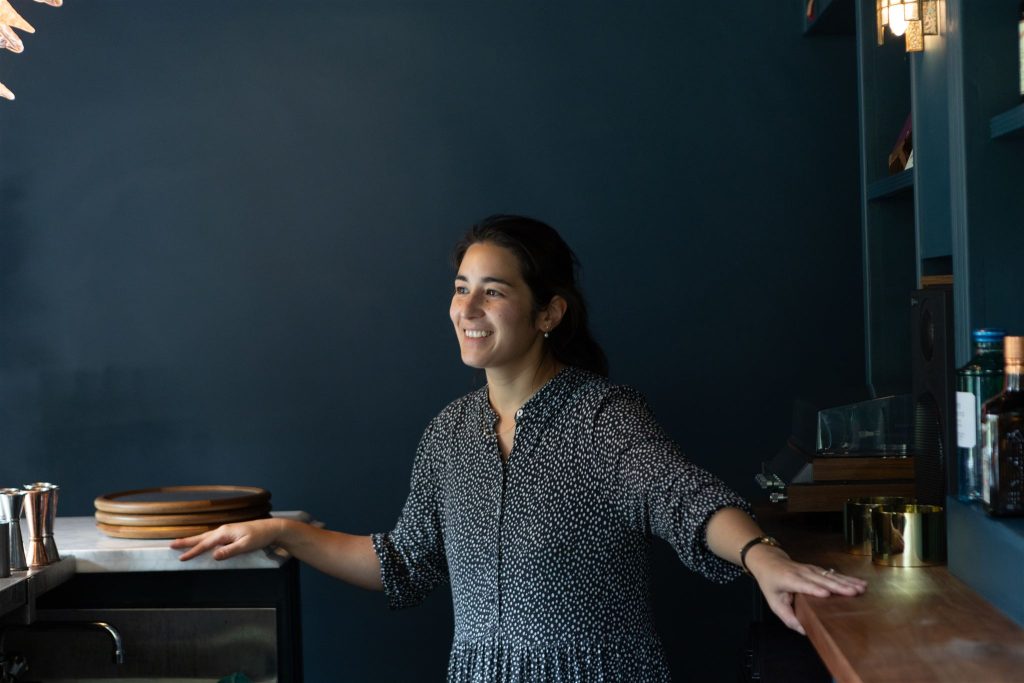
Nor do Cairngorms’ hikers have to put up with soggy sarnies and over-stewed coffee any longer; they can now sip speciality arabica brews from local roasteries like Glen Lyon and Roaring Stag, and grab a venison salami and kimchi-stuffed brioche roll from Tarmachan Café. Then reward their exertion with a craft IPA at Wasted Degrees’ taproom in Blair Atholl, or a treat from Explore Chocolate, where single-origin cacao is infused with avant-garde flavours, from yuzu and black sesame to red onion tarte tatin.
So why’s all this happening here, now? ‘I think as more people, particularly a new generation, are moving back to the Cairngorms as a more affordable and attractive living option, this inevitably results in more exciting places to eat and drink popping up across the region,’ Sherry observes. These homecomings have brought a world of culinary influences and ambition into one of Britain’s wildest places.
At Killiecrankie House, Tom and his wife Matilda exemplify this movement, with both having quit corporate careers to turn a beloved but tired guesthouse – ‘lots of tartan and threadbare carpets’, Matilda recalls – into the fine-diner it is today. Their menu takes cues from kaiseki, Japan’s multi-course set meals, where, Tom says, ‘everything must be seasonal and beautiful’, stemming from the couple’s stint in Tokyo, and Fife-born Matilda’s Japanese heritage. ‘There are so many crossover ingredients, from venison to seaweed, berries to plums,’ Tom points out. ‘The love of a deep-fry is also shared,’ Matilda laughs, ‘only there, it’s called tempura.’
Killiecrankie’s kitchen garden supplies most of the fresh ingredients – and some clever substitutes, too. ‘Try this,’ Tom urges, handing over what looks like a tiny broad bean. It tastes of wasabi. ‘Nasturtium pod! But tastes just like wasabi, doesn’t it?’ It is this dexterity that draws diners from far and wide. These cross-continental reference points have inspired the chef to turn oats into a glistening orb of tofu, anointed with the fiery fermented bean sauce doubanjiang; to lace toffees with smoked rice vinegar for petits fours; and to pair the sweet-sour tang of salt-pickled plums, called umeboshe in Japan, with chamomile, resulting in a complex non-alcoholic pairing.
Glowering behind us, bruised with heather and bracken, the peak of Ben Vrackie roots us firmly in the Highlands, yet the flavours Tom serves cast these mountains in a novel glow. ‘What does “Scottish cuisine” even mean?’ he shrugs. ‘I just know this is food that can only be made by us, right here.’