
In Mediterranea, Anastasia Miari chronicles a decade spent in grandmothers’ kitchens. Here, she reflects on their wisdom – and that of her own yiayiá
There’s something to be said for legacy and the written word. For centuries, women like my yiayiá (my Greek grandmother) shaped food cultures, yet their stories largely went unrecorded. We know history was primarily written by men, but our cuisines have been forged by women just like those I feature in my books. It makes a lot of sense to me to document their stories and preserve their life-perfected recipes and culinary skills for generations to come.
Throughout my travels, the flavours have varied enormously: harissa heat in North Africa; sumac in the Levant; garlic-laden plates in France. Yet there’s an ingrained food philosophy that unites the women of the Mediterranean, known as cucina povera – the art of making what little you have go a long way. We might think of it as ‘grazing’ – this serving of small bites before or between meals. Above all else, it’s an impassioned – and, quite frankly, pathological – approach to hospitality and need to share food.
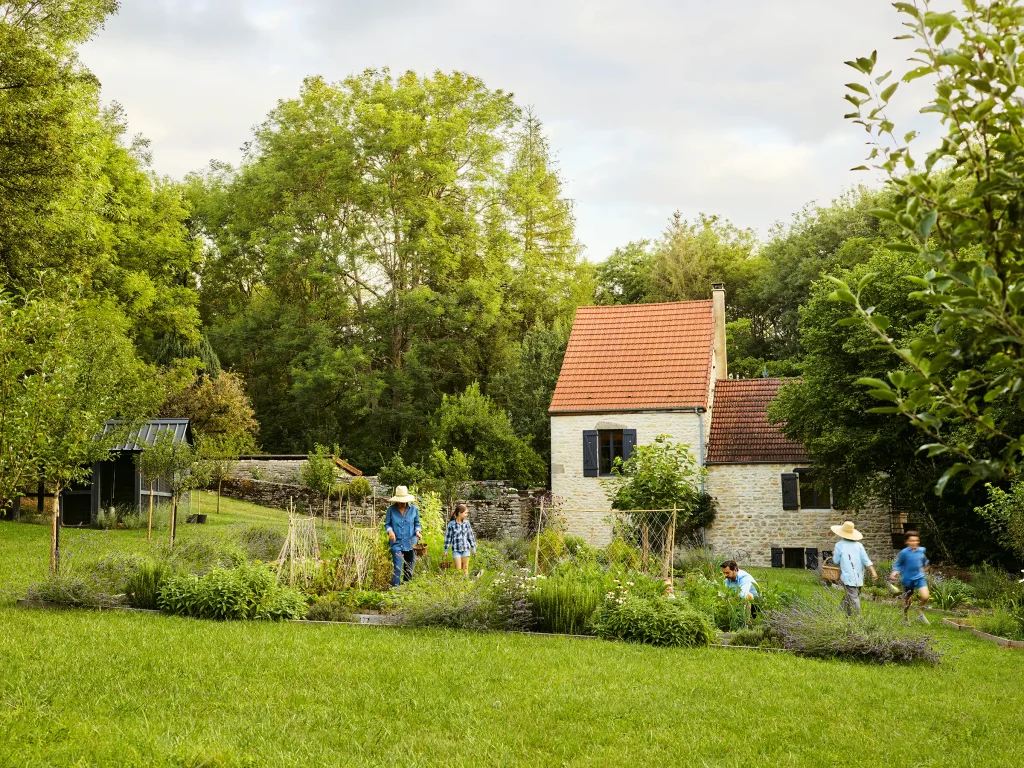
Beyond the delicious, no-frills meals and wholesome produce, what inspired me most was the way these grandmothers threw open their crochet-curtained doors, welcomed me as family and fed me to bursting. It’s a spirit I hope to carry forward as a next-generation Mediterranean matriarch. After all, this is not a study of cooking in the past – it’s about how those recipes and rituals can, and should, shape the way we live today.
A whole glass may feel outrageous, but that’s really how these women cook – and undoubtedly what makes their food so delicious. The amounts have often made my jaw drop – especially in the dishes we call ladera (oily) here in Greece – but the truth is that most Mediterranean dishes require plenty of good quality extra virgin olive oil and there’s no getting around it.
‘Ripe and ready’ labels on supermarket packaging stopped us from really feeling our produce. When my godmother wants to check the ripeness of a watermelon grown on her farm in Corfu, she’ll knock on it for a hollow sound. I dare not break it to her that pre-sliced watermelon exists in plastic packages.
Ripeness aside, the grandmothers in this book use their hands as whisks (splayed fingers mixing cake ingredients), as food processors (squishing tomatoes in their palms) and so much more. The sensations of cooking are almost as important as the sensations of eating: they help us connect with our food.
Hospitality is another thing that singles these women out. Their doors are always open wide and they forever have space at the table for an extra guest. Whether it’s a jar of biscuits to go with a pick-me-up espresso or a tray of lasagne waiting in the fridge, Mediterranean grannies somehow always have a ‘snack’ (or something larger) set aside with which to welcome visitors.
Like many others, my yiayiá is a zero-waste hero. It’s rare for her to throw out a single thing – why would you when a plastic feta tub doubles as a perfectly good lunch box to pack with edible leftovers? In Italian kitchens, water is swirled round empty jars of passata to dislodge remnants. Leftover bones from roasting meat might go into a broth, and beetroot tops are transformed into steamed greens. The prize, perhaps, went to a Turkish nonagenarian I met, called Ayten, who used the remnants of ash from a wood-fired oven to bake her kalburabasti biscuits instead of bicarb. For a nonna, it’s always preferable to use what she has.
I remember speaking to Sicilian-born Carmela as she stirred a rich tomato sugo through an aubergine pasta alla Norma: ‘Why I don’t eat fresh tomatoes in winter? It’s simple. They don’t taste good.’ Most of us are privileged enough to have year round availability of ingredients, but you’ll never catch a Mediterranean matriarch eating a tomato in November or December.
It’s not just what nonnas cook; it’s how they cook. I’m in awe. In Tunis, grandmother Houria told me, ‘We mustn’t bother our food too much,’ as I attempted to stir a bubbling pot of stew she’d left to simmer on the stove. She danced around the kitchen like a fairy, charring aubergine for a salad, boiling carrots and pickling turnips – stepping away and allowing each dish to do its own thing once she’d combined the ingredients.
Nonnas have a very hard time measuring anything. Most of them don’t own a pair of kitchen scales or measuring jugs and neither are they pleased when I ask them to count out the spoons of olive oil they’re adding to a dish.
It seems counterintuitive to write this, as a cookbook author, but don’t be a slave to a recipe. Season to your own taste and keep tasting as you go. If a lemon doesn’t feel very juicy, try the dressing and add a squeeze more from a second lemon. Prefer a bit more of a kick in your Tunisian chickpea soup? By all means add another teaspoon of harissa. These women are experts, not perfectionists.
This is actually the saying of my Yorkshire granny on my mother’s side, Joan, but it applies to all the grandmothers I’ve cooked with. To my mother-in-law, Chiara, whose pasta all’Amatriciana features in the book, dessert is not a ‘treat’ but a God-given right. On arrival at Nonna Italia’s in Naples, my request for water was greeted with derision. ‘Water will rust your bones,’ she said, insisting we drink wine as we cooked. As did Palermitan Marisa, who made the epic cassata Siciliana (pictured on p69) with me, using marzipan, sugar, chocolate chips and icing sugar in excessive quantities, while insisting that cassata would not be cassata if it did not ‘sweeten you’.
Eat a little of what you love: it’s essential for the soul.
The dessert to beat all desserts, tiramisù has always been my favourite sweet ending to a meal, but when I moved to Sicily a few years ago to learn Italian and realised tiramisù literally means ‘pick me up’, I fell in love with this dolce all over again.
With photography by Marco Argüello (Quadrille, £28).